Nobody's saying you shouldn't open a companion app on a bad day; many people find it soothing. The point is to be clear about what you're actually talking to, so you can use it where it's strong and look elsewhere where it isn't.
What only a therapist brings
Training and assessment. Clinicians learn to spot the signs of depression, anxiety, trauma and danger, and to choose a method that fits you. A companion simply answers whatever text arrives.
Accountability. Psychologists and other health practitioners in New Zealand are registered with a statutory authority and held to professional standards, and serious failures can cost them registration. An app is held to its own terms and conditions.
Constructive pushback. Part of good therapy is having a damaging belief tested, kindly and at a sensible time. Companions lean towards agreement, which feels supportive but may quietly strengthen the thinking you most need to examine. See setting boundaries with an AI partner.
Memory you can count on. Your therapist remembers your March session because they took notes and reflected on them. An app holds snippets and summaries that can drop out unnoticed or be filled with invented detail. See why AI companions invent memories.
Confidentiality with limits set by law. Clinical records fall under health privacy obligations that have set exceptions. Companion chats fall under a company policy that may permit staff reading, training a model and passing data to partners.
Comparison at a glance
| Therapist | Mental-health app | AI companion | |
|---|---|---|---|
| Purpose | Treatment | Guided self-help | Company and entertainment |
| Can assess or diagnose | Yes | No | No |
| Answerable to a regulator | Yes, registered practitioner | Limited, depends on the product | No |
| Privacy protection | Health privacy obligations | Varies | Company policy |
| Will challenge you | Yes, on purpose | Sometimes, by design | Rarely |
| There at 2 am | No | Yes | Yes |
| Cost | Highest | Low | Low to medium |
| In a crisis | Acts on it | Points you elsewhere | Points you elsewhere |
Where a companion earns its place
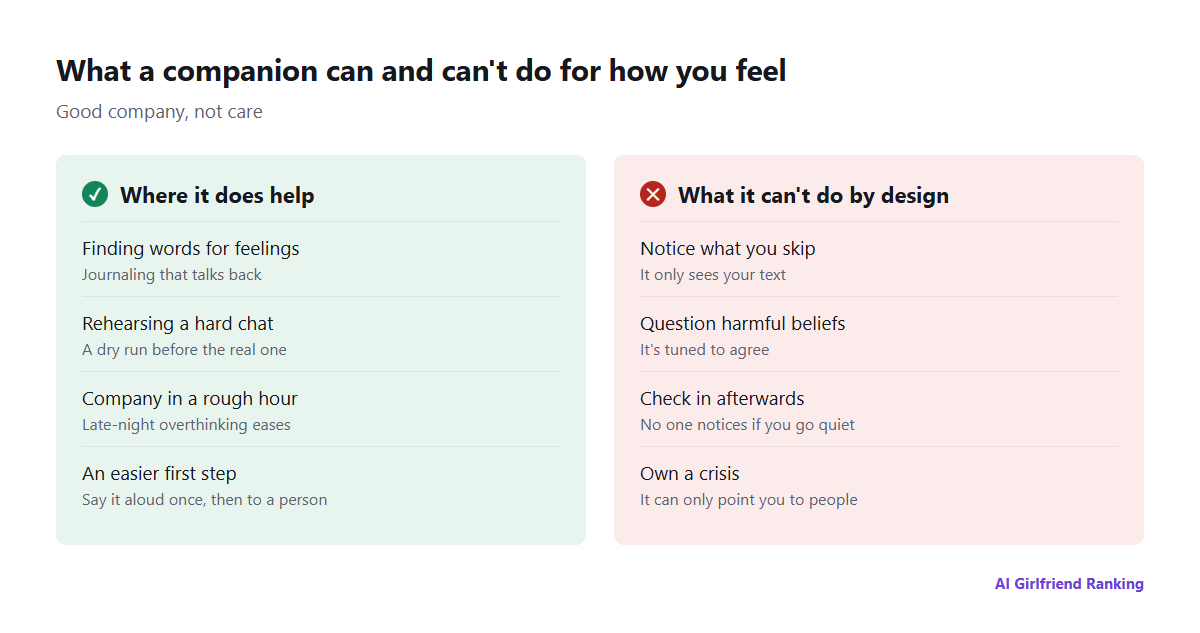
Company is not the same as care.
- Naming what you feel. Even talking to software can clarify your own thinking, much like journaling where the page answers.
- Practising a hard talk. Working out how to say something to a partner, parent or manager is among the most valuable things these apps do. See practising conversation with an AI companion.
- Someone there when it's rough. Spiralling thoughts at night weigh less with a voice to answer. That's fine so long as it stays about an hour.
- A softer first step. Some people voice a worry to a companion before telling anyone real. Fine, provided it eventually leads to a person.
Built-in blind spots
- It can't see what's missing. A therapist catches the hesitation, the subject you sidestep and how you've changed since last month. An app has only typed words.
- It nods along with distorted thinking. Something like "everyone's better off without me" is precisely what a warm, agreeable system may end up confirming in the name of being supportive.
- Nobody follows up. Go quiet for a week and no one checks in. A push notification is about keeping you engaged, not caring for you.
- Its incentives differ. A therapist aims to make themselves unnecessary; a companion's revenue relies on your return. See how AI companion apps make money.
How New Zealand treats this
No New Zealand law forbids an AI from offering emotional support, and there is no AI-specific law at all, but a few parts of the framework touch the area.
- Privacy law. The Privacy Commissioner says the Information Privacy Principles apply to generative AI chatbots, and advises against putting personal information into AI tools.
- Proposed age rules. A bill introduced on 24 August 2026 would require operators of age-restricted platforms, including social AI companions, to stop under-16s holding accounts and to assess child-safety risks every year. It is not law and is unlikely to pass this term.
- Abroad. Australia's age-restricted material codes, operating in full from 9 March 2026, expect companion chatbots to supply crisis and mental health information and shield children from sexually explicit content. New Zealand has no equivalent yet.
For contrast, some US states have gone further, with Illinois limiting AI therapy to licensed professionals and Utah setting disclosure rules for mental-health chatbots. The common message: an AI may keep you company, but it shouldn't label that therapy.
When to bring in a person
Book in with your GP or a psychologist if a low mood hangs around beyond a fortnight, if it's disrupting sleep, work or relationships, or if you notice you need the companion to get through your day. Many GP practices offer free brief wellbeing support through the government-funded Access and Choice programme, though it is rolled out by region, so ask the practice. The warning signs are set out in when an AI companion starts taking more than it gives.
If you're considering harming yourself, don't wait and don't rely on an app. Call or text 1737 at any hour, free. Lifeline Aotearoa is on 0800 543 354 or text 4357 (check its current hours, and use 1737 overnight). If someone's life is in immediate danger, ring 111.
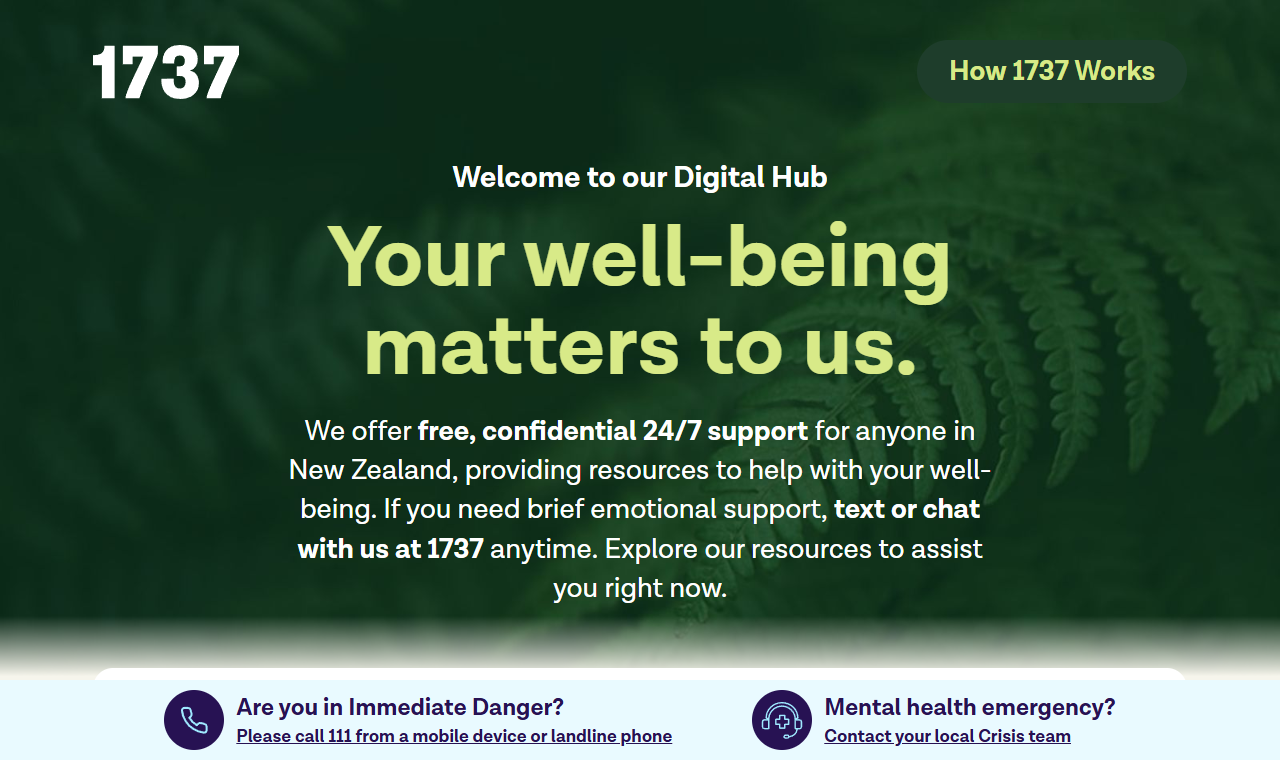
1737.org.nz: call or text 1737, any time.
A companion can be one helpful piece of how you look after yourself. It makes a poor replacement for someone looking after you.